Protect Your Privacy. Secure Your Finances. Explore the Future of Cybersecurity.
Top 5 Open-Source 2FA Apps for Privacy-Conscious Users (2025 Guide)
Marty Olo
12/1/2025
When it comes to protecting your online accounts, Two-Factor Authentication (2FA) remains one of the most effective defenses against credential theft. But as digital privacy becomes more important than ever, many users are turning away from closed-source authentication tools in favor of open-source 2FA apps—solutions that emphasize transparency, auditability, and community-driven security.
If you’re a privacy-conscious user, this guide highlights the Top 5 Open-Source 2FA Apps worth considering in 2025. We’ll cover their features, security practices, pros, cons, and why they stand out compared to proprietary alternatives.
Why Open-Source 2FA Apps Matter
Before jumping into the list, here’s why open-source matters in cybersecurity:
Transparency: Anyone can inspect the code for hidden tracking or vulnerabilities.
Community Security Audits: Flaws are identified and patched faster.
No Vendor Lock-In: Many apps allow easy import/export of 2FA tokens.
Privacy First: Minimal or no data collection.
Long-Term Sustainability: Even if a developer stops updating, the community can continue the project.
If you rely on closed-source apps like Google Authenticator or Authy, switching to open source can significantly strengthen your privacy posture.
1. Aegis Authenticator – The Gold Standard for Android Privacy
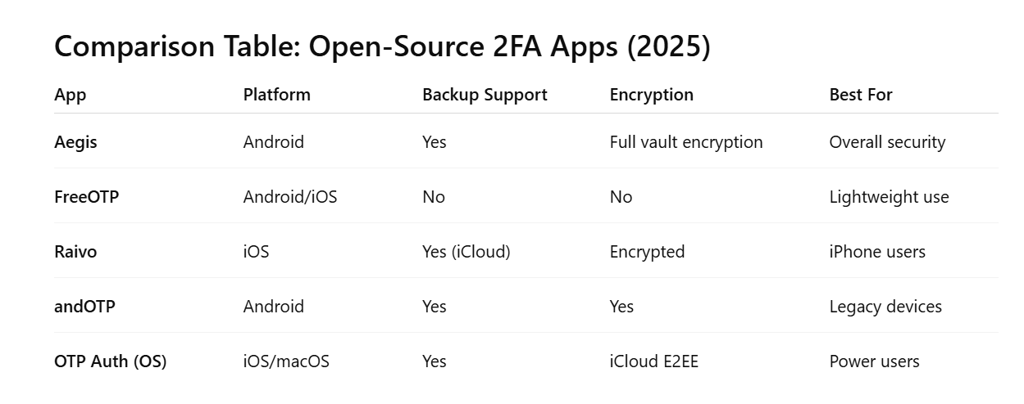
Best For: Android users seeking strong encryption, backups, and a modern UI
Platform: Android
License: Open Source (GPLv3)
Aegis has quickly become the top open-source 2FA solution, thanks to its security-focused design. It offers robust local encryption, secure biometric unlocking, and seamless backup/restore functionality.
Key Features
Military-grade AES encryption for all stored 2FA entries
Biometric or passphrase-based vault locking
Encrypted backups (local or cloud of your choice)
Import support from Google Authenticator, Authy, FreeOTP, Raivo, and more
Sleek UI with tagging and sorting options
Why Privacy Users Love It
Aegis stores everything fully offline and encrypts your entire vault. You control your data—no tracking, accounts, or servers involved.
Pros
Exceptional app security
Easy token migration
Completely free, no ads
Cons
Android only
No built-in cloud service (privacy-friendly but inconvenient for some)
2. FreeOTP – A Lightweight, No-Nonsense 2FA App
Best For: Users who want the simplest possible open-source authenticator
Platform: Android, iOS
License: Apache 2.0
Developed originally by Red Hat, FreeOTP is a minimal but trustworthy 2FA app. It lacks advanced features like encrypted backups or categorization—but that’s the point. It’s built to be small, reliable, and private.
Key Features
TOTP and HOTP support
QR code scanning
Zero data collection
Very lightweight
Why Privacy Users Love It
It’s one of the few open-source 2FA apps available on both Android and iOS. The codebase is tiny, making it easier to audit and trust.
Pros
Extremely lightweight
Cross-platform
Fully transparent
Cons
No backup/restore
Basic UI
No encryption options
3. Raivo OTP – The Best Open-Source 2FA Option for iOS
Best For: Privacy-focused iPhone users
Platform: iOS
License: MIT
iOS users have fewer open-source options, but Raivo OTP fills the gap beautifully. Stylish, intuitive, and open-source, Raivo focuses on clean design without sacrificing privacy.
Key Features
iCloud Keychain encrypted backups
Autofill support for iOS
Metadata masking (to avoid leaking issuer info)
Easy token import/export
Why Privacy Users Love It
Raivo balances Apple’s ecosystem convenience with open-source transparency—something rarely seen on iOS.
Pros
Best privacy-friendly iOS UI
Secure encrypted syncing
Active development
Cons
iOS only
Requires iCloud if you want backup syncing (still encrypted)
4. andOTP – A Reliable Classic for Android (Community Maintained)
Best For: Legacy Android devices and users wanting stability
Platform: Android
License: GPLv3
Though its original developer stepped away, the community maintains forks of andOTP that remain stable and secure. It focuses on simplicity while offering core security options.
Key Features
Encrypted backups
Multiple backup formats
TOTP/HOTP support
Minimal permissions
Pros
Mature and battle-tested
Lightweight and fast
Offline and private
Cons
Not actively developed by original author
UI feels dated compared to Aegis
Fewer customization options
5. OTP Auth (Open-Source Edition) – Power User Features
Best For: Users who want advanced customization and multi-device sync
Platform: iOS, macOS
License: Open-source fork
OTP Auth offers deep customization rarely found in other 2FA apps. The open-source edition (separate from the App Store’s paid version) gives you flexibility without privacy compromises.
Key Features
Folder organization for tokens
iCloud end-to-end encrypted sync
Custom icons and labels
Secure token sharing
Pros
Great for managing large sets of tokens
Multi-device sync
Detailed organization features
Cons
Open-source version requires manual installation (depending on build)
Feature-heavy UI might overwhelm beginners
How to Choose the Best Open-Source 2FA App
When selecting your authenticator, consider:
1. Platform Compatibility
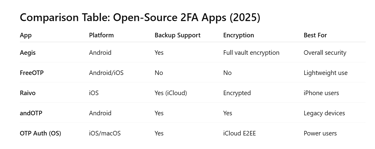
Android users: Aegis → Best choice
iOS users: Raivo → Best balance of privacy and usability
2. Backup Needs
If you want encrypted backups:
Aegis
Raivo
OTP Auth
If you prefer no backups for maximum security:
FreeOTP
3. UI & Ease of Use
Clean and modern: Aegis, Raivo
Minimalist: FreeOTP
Final Thoughts: Why These 2FA Apps Matter in 2025
The cybersecurity landscape is shifting fast. With data breaches rising and online threats becoming more sophisticated, relying solely on passwords—and especially on closed-source 2FA apps—can leave privacy-conscious users vulnerable.
Open-source 2FA apps like Aegis, Raivo, FreeOTP, and others give you the transparency and control you deserve. Whether you're looking for strong encryption, offline storage, or cross-platform support, there’s a secure, community-audited option available.
If you care about privacy, digital independence, and security-driven design, switching to an open-source 2FA solution in 2025 is one of the smartest decisions you can make.
Stay Secure, Stay Informed
Your source for online privacy and protection.
Copyright © 2026. - PrivyShield - All rights reserved.