Protect Your Privacy. Secure Your Finances. Explore the Future of Cybersecurity.

YubiKey vs SoloKey: Battle of the Open-Source vs Proprietary
Marty Olo
12/1/2025


YubiKey vs SoloKey: Which Security Key Should You Trust in 2025?
Hardware security keys have become the gold standard for protecting accounts from phishing, SIM swaps, and credential stuffing. In 2025, two of the most talked-about options are YubiKey and SoloKey—one proprietary and enterprise-focused, the other fully open-source and transparency-driven.
If you’re trying to choose between the two, this guide breaks down the real differences so you can pick the one that fits your security, trust, and compatibility needs.
What Are YubiKey and SoloKey?
YubiKey
A hardware key made by Yubico, known for:
Rock-solid build quality
Broad enterprise adoption
Support for FIDO2, WebAuthn, OTP, Smart Card, and more
Proprietary firmware (closed-source)
SoloKey
A hardware key created by SoloKeys.io, known for:
100% open-source firmware
Transparent security model
Affordable price
Focus on community and trust-by-audit
FIDO2/WebAuthn support
1. Security: Which Key Is More Trustworthy?
YubiKey Security
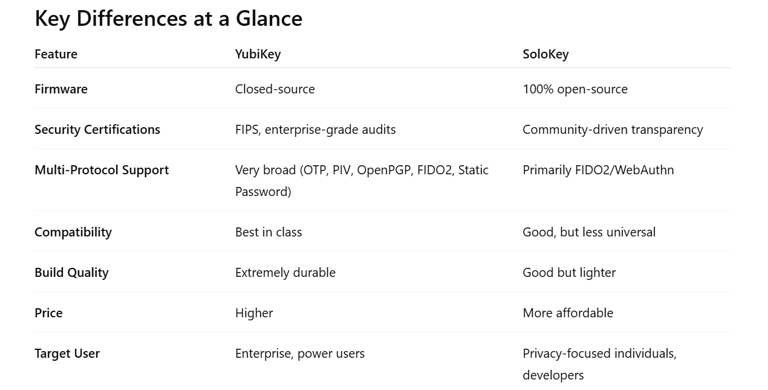
YubiKey uses a proprietary firmware, meaning you cannot inspect the source code.
However, they are:
Used by Google, Microsoft, and top enterprises
Highly audited
Resistant to physical tampering
Certified with security standards like FIPS 140-2
Bottom Line: Trust is placed in Yubico’s reputation and enterprise-level testing.
SoloKey Security
SoloKey’s firmware is fully open-source, making it:
Transparent
Auditable
Verifiable by anyone
Preferred by privacy enthusiasts and security researchers
They also use secure hardware with anti-tamper protections.
Bottom Line: Trust comes from open-source transparency, not secrecy.
2. Compatibility: YubiKey Still Wins Here
If you need maximum website and app compatibility, YubiKey leads the market.
YubiKey supports:
Windows Hello
macOS
Linux
Google accounts
Microsoft 365
GitHub
AWS
Okta
1Password
Facebook
Dropbox
Salesforce
Hundreds more
SoloKey works with all FIDO2/WebAuthn websites, but:
Lacks full enterprise protocol support
Isn’t as widely officially recognized
Doesn’t support PIV/Smart Card or OTP modes
If your job involves identity access management or enterprise platforms, YubiKey is the safer bet.
3. Features: What Can Each Key Actually Do?
YubiKey Features
Supports multiple security modes:
FIDO2
WebAuthn
U2F
One-Time Password (OTP)
Smart Card (PIV)
OpenPGP
SSH with hardware-backed keys
Static Password Mode
This flexibility makes YubiKey the Swiss Army knife of authentication.
SoloKey Features
SoloKey primarily focuses on:
FIDO2
WebAuthn
U2F
This keeps it simple and open-source but less multi-purpose.
4. Build Quality and Durability
YubiKey
Built like a tank:
Waterproof
Crush-resistant
Heat resistant
Keychain-friendly
These keys routinely last many years.
SoloKey
Still durable but:
Lighter plastic
Not as rugged
Not meant for extreme wear-and-tear
Great for normal everyday use, but not the same industrial-grade finish.
5. Pricing: SoloKey Is More Budget-Friendly
ProductPrice RangeYubiKey 5 Series$50–$90+SoloKey$25–$45
If you’re buying multiple keys for backup, SoloKey offers solid value.
6. Privacy & Trust: Open-Source vs Proprietary
This is where opinions vary:
Why People Trust YubiKey
Long history in cybersecurity
Used by major companies
Passed several third-party audits
Proven track record preventing phishing attacks
Why People Trust SoloKey
Fully open-source (no secrets)
Anyone can inspect or compile the firmware
Transparency = confidence
Popular among free software supporters and cryptography researchers
If transparency matters more than mainstream adoption, SoloKey is appealing.
Which One Should You Choose?
Choose YubiKey If You Want:
✔ The most compatible hardware key
✔ Enterprise-level security
✔ Multi-protocol support
✔ Rugged durability
✔ Proven real-world adoption
Best for: professionals, system administrators, IAM engineers, businesses, Google/Microsoft ecosystems.
Choose SoloKey If You Want:
✔ Fully open-source firmware
✔ Lower cost
✔ Transparent and verifiable security
✔ A simple FIDO2/WebAuthn-only solution
Best for: privacy fans, developers, open-source advocates, budget-conscious users.
Final Verdict: YubiKey vs SoloKey
YubiKey wins on compatibility, features, and durability.
SoloKey wins on transparency, simplicity, and price.
Your choice depends on how you define “trust”:
Trust the company? → go YubiKey
Trust the open-source code? → go SoloKey
Both are excellent for strong 2FA and passwordless security in 2025.
Stay Secure, Stay Informed
Your source for online privacy and protection.
Copyright © 2026. - PrivyShield - All rights reserved.